

Introduction
A semi trailer tire inflation system—commonly called an automatic tire inflation system (ATIS)—maintains trailer tire pressure automatically while the vehicle is in motion, using compressed air from the trailer’s existing brake system supply. The system routes air through a pressure protection valve, a control box, the axle tubes, and rotary unions at each wheel end, delivering air to any tire that falls below the set pressure . Check valves isolate each tire so that a single leak does not drain the others, and an indicator lamp on the trailer alerts the driver when the system is actively inflating .
The operational case for ATIS rests on a measurable cost problem. Industry data indicates that roughly one-third of trailer tires are underinflated, and underinflation by just 10 psi increases fuel consumption by 0.5% to 1% . A tire underinflated by 10 percent loses 16 percent of its usable life; at 30 percent underinflation, the loss reaches 55 percent . Trailers are especially vulnerable because maintenance is infrequent—often once or twice per year—and trailers sit unattended for extended periods, allowing pressure loss to go unchecked . An automatic system addresses this gap by maintaining pressure continuously rather than relying on periodic manual checks.
This guide examines the engineering and commercial factors that define semi trailer tire inflation system selection and maintenance: how the system works, the specifications that govern its operation, and the maintenance practices that keep it reliable.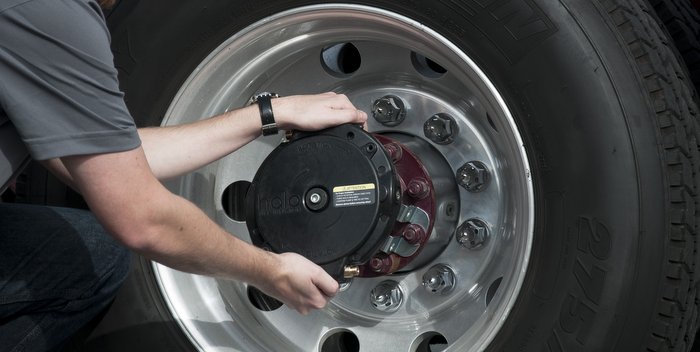
Core Powertrain and Structural Design
Engine and Transmission
A semi trailer tire inflation system has no relationship to the tractor’s engine or transmission. It is self-contained on the trailer, drawing air from the trailer’s air tank through a pressure protection valve that ensures the brake system retains priority . This self-contained design means the system can be used with any tractor, regardless of make or model .
Hydraulic System
The system is pneumatic, not hydraulic. Air flows from the trailer supply through a control box that regulates pressure, then into the axle tubes. The axles act as conduits, carrying air to a rotary union at each spindle end, which transfers air from the stationary axle to the rotating hub and then to the tires through flexible hoses . The rotary union is typically the system’s only moving part, which contributes to its relatively low maintenance burden .
Chassis and Structural Durability
The system’s reliability depends on the integrity of several interfaces. Wheel-end seals must prevent grease from contaminating the air path and prevent air from escaping into the hub. Hendrickson’s TIREMAAX PRO documentation specifies an in-axle filter to prevent hub contamination and vents excess air through the axle vent rather than the wheel end . Tire hoses at each hubcap must be secure and free of chafing; CVSA inspection guidance notes that with ATIS installed, the tire hose is an extension of the tire, meaning pressure measured at the disconnected hose reflects actual tire pressure .
The pressure protection valve is the safety-critical component that isolates the tire inflation system from the brake system. It ensures that a major tire system leak cannot deplete the trailer’s brake air supply below safe operating pressure . This valve should be inspected at every system service.
Technical Specifications
The table below presents representative parameters for semi trailer automatic tire inflation systems, drawn from published manufacturer specifications and inspection guidance. Values vary by system model and trailer configuration.
| Key Parameter | Typical Technical Specification | Operational Significance |
|---|---|---|
| Tire pressure setting range | 85–120 psi (586–827 kPa) for Hendrickson TIREMAAX PRO | Covers common trailer tire pressures; adjustable to OEM cold inflation specification |
| Pressure check interval | Continuous while in motion | Maintains pressure proactively rather than at manual check intervals |
| Inflate capacity (example) | 10 psi in approximately two minutes for one tire | Indicates how quickly a slow leak is corrected under normal operation |
| Maximum axles supported per controller | Up to four axles (example system) | Determines system suitability for multi-axle trailer configurations |
| Wheel styles supported | Steel and dual configurations | Must match the trailer’s wheel and hub specification |
| Indicator lamp behavior | Illuminates during inflation; remains on if leak persists | Driver warning of active leak; if on for more than 10 minutes, inspect for damage |
| Maintenance interval (system integrity) | Every three months: indicator lamp test, manual tire check, hose inspection | Catches system faults before they affect tire pressure maintenance |
| Annual inspection | All air fitting connections soap-tested for leaks; regulator pressure verified | Confirms system integrity and correct pressure setting |
Comparative Advantages TCO and ROI
The alternative to an automatic inflation system is manual pressure maintenance—periodic checks with a gauge and inflator. The comparison is not simply system cost versus labor cost; it is the cost of the underinflation that manual programs fail to prevent.
A published fleet case illustrates the operating rationale. Manfred Jungels GmbH, a German logistics operator running nearly 60 tractors and about 70 semi-trailers, has used BPW AirSave since 2019 and now specifies it on every new trailer. The fleet manager states that if tire pressure drops by 20 percent, fuel consumption rises by up to 5 percent, and the system provides real-time relief for drivers who perform departure checks but do not constantly check tire pressures . The system also provides a safety margin: in a sudden pressure loss, it pumps against the drop so the driver can reach a workshop safely .
A defensible cost comparison requires stated assumptions. Consider a fleet of 40 trailers, each running 100,000 km per year. Assume a diesel price of 7.5 CNY/L and baseline consumption of 35 L/100km. A sustained 10 psi underinflation—well within the range that manual programs often miss—increases fuel consumption by 0.5% to 1% . At the midpoint of 0.75%, the annual fuel penalty per trailer is approximately 1,970 CNY. Across 40 trailers, the fleet-level penalty is roughly 78,700 CNY per year. An automatic inflation system that eliminates chronic underinflation and preserves tire life at the same time addresses both the fuel penalty and the tire replacement cost. Against a per-trailer system cost that varies by model and installation, the payback calculation should include both fuel savings and the extended tire life documented in industry data—16 percent loss of usable life at 10 percent underinflation .
Tire life preservation is the larger long-term benefit. A trailer tire underinflated by 20 percent can lose roughly 30 percent of its tread life . For a fleet spending tens of thousands of currency units per year on trailer tires, preserving casing life and retread potential changes the cost per kilometer materially.
Heavy Duty Application Scenarios
-
Long-haul highway fleets: The system maintains pressure through temperature swings and slow leaks that develop over thousands of kilometers. The driver receives an indicator lamp warning if a leak exceeds the system’s inflation capacity, allowing a planned stop rather than a roadside failure .
-
Trailer pools and drop-and-hook operations: Trailers that sit unattended for extended periods are the highest-risk category for undetected pressure loss . An ATIS with wheel valves that isolate tires when the parking brake is set maintains pressure during idle periods and prevents the slow bleed that manual programs miss .
-
Container drayage and port operations: Short trips and frequent coupling cycles leave little time for manual tire checks. The system’s continuous operation during motion compensates for the lack of routine inspection windows.
-
Cold climate operations: Temperature drops reduce tire pressure, and the system compensates automatically. However, moisture in the air supply can freeze at the rotary union or control box, so air dryer maintenance on the tractor becomes a determinant of ATIS reliability.
Selection and Maintenance Considerations
Selecting a semi trailer tire inflation system begins with the trailer’s axle configuration and operating environment. The system must support the number of axles on the trailer, match the wheel and hub specification, and be compatible with the air supply available from the tractor.
Key maintenance practices include:
-
Test the indicator lamp every three months. Confirm the lamp illuminates when the system is active and extinguishes when pressure is maintained. A lamp that stays on for more than 10 minutes during operation indicates a leak requiring inspection .
-
Manually check tire pressure at defined intervals. Even with ATIS installed, manual checks confirm the system is delivering the set pressure. The tire hose can be disconnected at the hubcap, and pressure measured at the hose reflects actual tire pressure . Hendrickson recommends manual checks every three months alongside the indicator lamp test .
-
Soap-test all air connections annually. Apply soapy water to fittings, the axle vent, and the control box connections. Bubbles indicate leaks that reduce system performance and waste air .
-
Verify regulator pressure against the tire manufacturer’s load and inflation table. The system’s set pressure should match the cold inflation pressure specified for the trailer’s axle load. An incorrect setting either leaves tires underinflated or causes excess pressure relief .
-
Keep the tractor air dryer in service. Moisture in the air supply attacks seals and valves in the ATIS. Air system maintenance on the tractor is a determinant of trailer ATIS reliability, even though the system itself is trailer-mounted.
Conclusion
A semi trailer tire inflation system addresses a measurable cost problem: chronic underinflation that increases fuel consumption by 0.5% to 1% per 10 psi and reduces tire life by 16 percent at 10 percent underinflation . The system maintains pressure continuously using the trailer’s existing air supply, with check valves isolating each tire and an indicator lamp warning of leaks that exceed the system’s inflation capacity . It is self-contained on the trailer and compatible with any tractor .
The engineering priorities are clear: verify the system’s pressure setting against the tire load table, maintain the rotary union and wheel-end seals, and test the indicator lamp and air connections at defined intervals. The commercial priorities follow: model the fuel and tire-life savings against the system cost, recognizing that the largest benefit accrues to fleets with high utilization and trailers that sit unattended between trips. The trailer whose tires stay at the correct pressure without daily manual attention is the one that delivers the fuel efficiency and casing life the fleet paid for.