

Introduction
An electric semi trailer truck is a Class 8 tractor unit powered by a battery-electric drivetrain rather than a diesel engine, coupled to a conventional semi trailer. Its commercial relevance has shifted from demonstration projects to fleet deployment decisions as battery capacity, charging rates, and model availability have matured. The current generation of production-intent vehicles offers range figures that vary widely by manufacturer and configuration: Tesla’s Long Range Semi is rated at approximately 500 miles with a battery capacity in the 850–900 kWh range, while its Standard Range variant delivers about 325 miles . Volvo’s next-generation FH Electric, using an integrated e-axle, targets up to 700 km (430 miles) in long-haul trim . These are manufacturer claims and configuration-dependent; actual range varies with payload, terrain, temperature, and driving style.
For fleet managers and procurement teams, the electric semi trailer truck is not simply a diesel replacement. It is a different asset with different constraints. The battery adds significant tare weight, reducing available payload within the same gross combination weight limit. The charging infrastructure required to keep the truck productive is a capital and operational commitment that does not exist in a diesel fleet. And the total cost of ownership calculation depends heavily on utilization, electricity price, and route profile—conditions that vary too widely for a universal answer. This guide examines the engineering and commercial factors that determine whether an electric semi trailer truck is a viable fleet asset.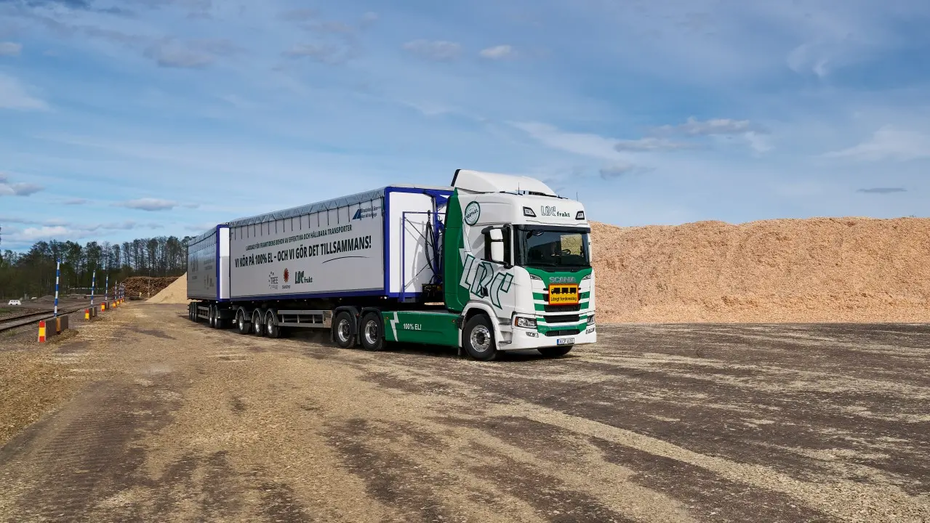
Core Powertrain and Structural Design
Engine and Transmission
The electric semi’s drivetrain replaces the diesel engine, transmission, and exhaust aftertreatment with a battery pack, power electronics, and one or more electric motors. Tesla’s Semi uses three permanent-magnet motors on the rear axles—two on a forward “torque drive axle” that engages under acceleration and grade climbing, and one on a rear “efficiency drive axle” that remains active at highway speed to reduce drag . The combined drive power is approximately 800 kW (about 1,072 hp) .
Volvo’s e-axle approach integrates a pair of electric motors and a multi-speed gearbox into the drive axle itself, freeing chassis space for additional batteries. Its long-haul configuration produces 460 kW (about 625 hp) and supports payloads up to 28 tonnes, while a more powerful 540 kW variant serves construction and vocational applications .
Hydraulic System
Electric semi tractors do not use hydraulic systems for propulsion. However, an electric power take-off (ePTO) is available on some models to drive auxiliary equipment—hydraulic pumps for dump trailers, refrigeration units, or liftgates—without running a separate engine. Tesla’s European Semi specification lists an ePTO of up to 25 kW . This matters for fleets that operate specialized trailers requiring hydraulic power; the ePTO capability determines whether the electric tractor can serve those applications without a separate power source.
Chassis and Structural Durability
The battery pack is the defining structural difference. In the Tesla Semi, the packs are mounted low between the frame rails, which lowers the center of gravity but adds substantial tare weight . The Long Range Semi’s curb weight is approximately 23,000 pounds, compared to under 20,000 pounds for the Standard Range variant . European regulators allow electric heavy trucks an additional 2,000 pounds of gross combination weight to partially offset battery mass, but this does not fully recover the payload lost to the battery .
The chassis and suspension must be designed for the battery’s mass and for the torque characteristics of electric drive. Regenerative braking—recovering energy during deceleration—reduces wear on the foundation brakes but places different loads on the driveline and axle components. The trailer’s brake system remains conventional pneumatic, and the coupling interface (kingpin, fifth wheel, air lines, and SAE J560 electrical connector) is unchanged.
Technical Specifications
The table below presents representative parameters for current electric semi tractor models. Values are manufacturer claims and configuration-dependent; actual performance varies with payload, route, temperature, and charging conditions.
| Key Parameter | Typical Technical Specification | Operational Significance |
|---|---|---|
| Tesla Semi Long Range battery capacity | ~850–900 kWh | Supports ~500 miles claimed range; adds significant tare weight |
| Tesla Semi Long Range range | ~500 miles (claimed) | Configuration-dependent; actual range lower with payload, grades, cold |
| Tesla Semi Standard Range range | ~325 miles (claimed) | Suitable for regional and drayage duty with depot charging |
| Tesla Semi drive power | ~800 kW (1,072 hp) | Comparable to or above diesel tractor ratings for grade performance |
| Tesla Semi curb weight (Long Range) | ~23,000 lb | Reduces payload within fixed GCWR compared to diesel tractor |
| Volvo FH Electric long-haul range | Up to 700 km (430 miles) | E-axle integration frees chassis space for additional battery capacity |
| Volvo FH Electric power (long-haul) | 460 kW (625 hp) | Supports up to 28 tonnes payload in long-haul trim |
| Charging rate (Tesla Megacharger) | Up to 1.2 MW; 60% in ~30 minutes | Requires dedicated high-power infrastructure; not available at all depots |
Comparative Advantages TCO and ROI
The electric semi’s total cost of ownership comparison with diesel hinges on utilization and energy price, not on purchase price alone. Electric tractors carry a substantial acquisition premium: in one documented Chinese fleet case, a 49-tonne electric semi tractor had a landed price of 850,000 CNY, compared to 400,000 CNY for an equivalent diesel unit—a difference of 450,000 CNY . That premium is driven primarily by the battery, which accounts for 40 to 50 percent of total vehicle cost in that market .
The operating cost advantage is real but must be large enough to recover the premium within the vehicle’s service life. The same Chinese fleet case reported energy costs of 160 CNY per 100 km for electric versus 280 CNY per 100 km for diesel—a saving of 120 CNY per 100 km . At an annual distance of 79,200 km, the annual energy saving is approximately 95,000 CNY. Against a 450,000 CNY premium, simple payback is roughly 4.7 years—and the report notes that in that operating region, heavy truck service life is commonly 4 to 5 years . The economics are marginal without incentives or a lower-priced battery solution.
The break-even utilization threshold is a more useful planning metric. The same source calculates that electric trucks achieve lower total cost of ownership than diesel once annual distance exceeds approximately 28,800 km . Below that threshold, the energy savings do not recover the capital premium. Above it, and with favorable electricity pricing (especially overnight off-peak charging), the electric truck can be cost-competitive.
A defensible comparison requires stated assumptions. Consider a fleet operating a 300 km daily round trip with overnight depot charging at off-peak rates. If the electric tractor’s energy cost is 40 percent lower than diesel per kilometer, and the fleet runs 250 days per year, the annual energy saving may be sufficient to recover a portion of the premium within the first ownership period. The calculation must include the cost of charging infrastructure—depot chargers, utility upgrades, and demand charges—which is not included in the vehicle purchase price and can add materially to the total investment.
Resale value for electric semi tractors is less established than for diesel units. Battery degradation over time affects both range and value, and the secondary market for high-voltage commercial vehicles is still developing. Fleets should model residual value conservatively rather than assuming parity with diesel.
Heavy Duty Application Scenarios
-
Regional and drayage operations: The most favorable duty cycle for electric semi trucks. Daily distances under 300 miles allow overnight depot charging with standard or moderately fast chargers, avoiding the need for public high-power infrastructure. Port drayage and short-haul distribution fit this profile.
-
Long-haul highway freight: Range and charging infrastructure are the limiting factors. A 500-mile range is sufficient for many routes, but the availability of high-power charging along the corridor determines whether the truck can complete the route without extended stops. Tesla’s Megacharger rollout and Volvo’s MCS charging support are expanding, but coverage is not yet universal .
-
Vocational and construction applications: The ePTO capability and higher-power variants serve dump, refuse, and construction duty cycles where hydraulic power is required and routes are short. Volvo’s 540 kW e-axle option targets these applications .
-
Cold climate operations: Battery range decreases in low temperatures, and cabin heating draws energy. Fleets operating in cold regions should plan for reduced effective range and potentially additional charging stops, particularly on routes near the range limit.
Selection and Maintenance Considerations
Selecting an electric semi trailer truck begins with the route and charging assessment, not the vehicle specification. The first question is: what is the daily distance, and can the truck return to a depot charger each night? The second is: what is the electricity price at the charging location and time, and is the local grid capable of supporting the charger’s demand?
Key considerations include:
-
Verify actual range against the route, not the brochure. Manufacturer range figures are configuration-dependent. Payload, terrain, temperature, and driving style all reduce range. Plan for a margin between the daily route distance and the claimed range.
-
Calculate the full charging infrastructure cost. Depot chargers, utility upgrades, demand charges, and any public charging subscriptions are part of the total investment. A vehicle purchase decision that excludes infrastructure cost understates the true capital requirement.
-
Confirm the ePTO capability for specialized trailers. If the fleet operates dump trailers, refrigerated units, or liftgates, verify that the electric tractor’s ePTO output is sufficient to drive the auxiliary equipment.
-
Model TCO against actual utilization. The break-even distance varies by electricity price, diesel price, and vehicle premium. A fleet running 20,000 km per year may not recover the premium; a fleet running 80,000 km per year with off-peak charging may. Use fleet-specific data rather than generic claims.
-
Plan for battery health management. The high-voltage battery is the most expensive component and the one with the greatest uncertainty in long-term value. Follow manufacturer guidance on charging windows, depth of discharge, and temperature management to preserve capacity and resale value.
Conclusion
The electric semi trailer truck is a viable fleet asset under specific conditions: a duty cycle that returns the vehicle to a depot charger each night, annual distance above roughly 28,800 km, electricity priced favorably against diesel, and a route profile that fits within the vehicle’s actual—not claimed—range. Under those conditions, the energy cost advantage can recover the acquisition premium within the ownership period. Outside those conditions, the electric truck remains a higher-cost alternative that requires incentives, policy support, or a strategic emissions mandate to justify.
The engineering priorities are clear: understand the payload penalty of battery mass, verify ePTO capability for specialized trailers, and plan charging infrastructure as part of the total investment. The commercial priorities follow: model TCO against fleet-specific utilization and energy prices, and treat resale value conservatively until the secondary market matures. The electric semi trailer truck that fits the route, the charger, and the balance sheet is the one that delivers the operating cost benefit the technology promises.