
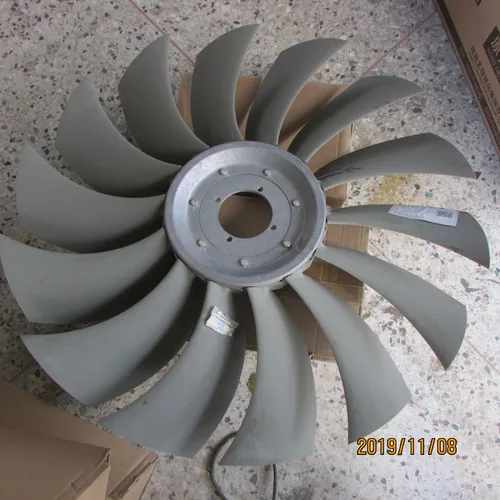
XCMG Spare: Axial Cooling Fan 800142147 | Φ700 PAG Blade 4-Blade 45°, Cooling System Radiator Fan
الحد الأدنى للطلب: 1 قطع
- Material code::
- 800142147
- Material Description::
- 700/14-14/45/PAG/4HL/BC96.8 fan
- السعر المرجعي:
- USD $178.00
- الحد الأدنى لكمية الطلب:
- 1 قطع

ميزات المنتج وتطبيقاته
This Axial Cooling Fan 800142147 is an axial heat-dissipation fan in construction-machinery cooling systems, associated with spec code 700/14-14/45/PAG/4HL/BC96.8—i.e., impeller diameter 700 mm, speed approx. 1440 r/min, blade angle 45°, glass-fiber-reinforced nylon (PAG) blades, 4-blade configuration, hub model BC96.8.
An axial fan (also called axial-flow ventilator) is the core aerodynamic component in a construction-machinery engine cooling system, mounted behind the radiator (water tank). Through blade rotation it generates axial airflow that carries away the heat absorbed by the radiator core and discharges it into the environment, thereby maintaining the thermal balance of the engine and the hydraulic/transmission oil coolers. Together with the water pump, thermostat, radiator, and fan shroud, it forms the forced-circulation cooling system of a diesel engine.
Technical characteristics of PAG blades (based on third-party blade-manufacturer public data, as background reference for this part, not specific to this item):
-
Material definition: PAG stands for Polyamide Glass-fiber reinforced—nylon matrix modified by adding glass-fiber reinforcement . Similar blade materials include PA (pure nylon 6, black, standard load), PAGST (impact-resistant type, suited to strong-vibration conditions), PACAS (conductive flame-retardant type, suited to explosive-hazard environments), and ALU (die-cast aluminum alloy, temperature range -40°C–150°C, suited to high-temperature conditions) .
-
Operating temperature: PAG blades suit a temperature range of -40°C to 110°C with excellent anti-aging performance, suited to heavy-load conditions .
-
Mounting angle: Blades are fixed to the hub via steel pins; the preset blade angle will not move or change under load, and the mounting angle can be customized between 25° and 50° .
-
Structural features: The airfoil-profile design of PAG blades gives the fan low noise, large air volume, high efficiency, and low power consumption; impeller diameters cover 250 mm–900 mm, making it a common configuration for small-, medium-, and large-size radiators, air-conditioning units, compressors, and cooling towers .
المواصفات الفنية
- Material code:
- 800142147
- Material Description:
- 700/14-14/45/PAG/4HL/BC96.8 fan
مواصفات التجارة
- السعر المرجعي
- USD $178.00
- الحد الأدنى لكمية الطلب
- 1 قطع


Xuzhou Hengming Machinery Equipment Co., Ltd.
Rooted in Xuzhou, the birthplace of XCMG brand and the core national industrial cluster for construction machinery, Xuzhou Hengming Machinery Equipment Co., Ltd. has long focused on the supporting spare parts industry for XCMG construction machinery. We hold official import and export business qualifications, and serve as a one-stop source supplier of spare parts for global XCMG equipment users.
- الموقع
- Room 115, D32# Block 1, Huaihai Hardware & Electromechanical Market, East Sanhuan Road, Xuzhou Economic & Technological Development Zone, Jiangsu Province, China
- الموظفون
- Less than 50 People
- مساحة المصنع
- 1,000-5,000 m²
- الإيرادات السنوية
- US$1 Million - US$5 Million
- الأسواق الرئيسية
- Europe / Middle East & North Africa / Africa