

Overview
Maximizing the efficiency of a hydraulic excavator in a mining environment is critical for reducing cost per ton and ensuring operational profitability. B2B procurement and fleet managers must navigate a complex set of variables, from pre-sales specifications like engine emissions and attachment compatibility to post-sales strategies for maintenance and spare parts management. This FAQ provides definitive, expert-backed answers to the most common questions regarding hydraulic excavator performance and longevity in surface mining applications, helping you optimize your fleet and meet production goals.
Frequently Asked Questions
Q1: What is the standard maintenance interval for a hydraulic excavator in a mining application?
The standard maintenance interval is not a single number, but a phased schedule that includes daily, weekly, monthly, and annual services, with major component rebuilds occurring every 3,000 to 5,000 hours . For example, daily and 60-hour (weekly) maintenance checks are standard . Major services, such as hydraulic tank cleaning and main pump inspections, are critical at the 1,000-hour mark. A comprehensive 3,000-hour major service often involves engine overhauls and hydraulic pump rebuilds, while the 10,000-hour mark typically calls for a complete rebuild of the engine, hydraulics, and undercarriage . Optimal maintenance intervals are determined by cost optimization models based on component failure rates (Weibull analysis) and the true cost of downtime .
Q2: What is the maximum bucket payload and engine power for a large mining hydraulic excavator?
The maximum bucket payload for the largest hydraulic mining excavators exceeds 80 tons per pass, with engine power reaching up to 2,236 kW (3,000 hp) . For instance, the Komatsu PC9000-12 can handle a payload of over 80 tons, achieving production rates of around 8,000 tons per hour . In comparison, the Cat 6060 series offers a bucket payload of 61.2 tons and a gross engine power of 2,236 kW . The Cat 6040 provides a 39.6-ton payload with a 1,550 kW engine . These specifications are crucial for matching the excavator to haul trucks and meeting high-volume production targets.
Q3: How does fuel efficiency impact the operational cost of a hydraulic excavator?
Fuel efficiency is a primary driver of total cost of ownership, and modern hydraulic excavators are engineered to deliver significant reductions in fuel consumption while boosting productivity. Advanced models, like the Komatsu PC950-11, can consume up to 40% less fuel than previous models while offering up to 48% greater productivity . This is achieved through redesigned hydraulic systems with electronically controlled closed-loop swing circuits and multiple selectable work modes (e.g., P+, P, and E) that allow operators to prioritize either power or efficiency based on the specific task . Improved fuel efficiency directly translates to lower operating costs and helps mining operations meet emissions and sustainability targets.
Q4: Why is attachment compatibility important, and what should I consider for my fleet?
Attachment compatibility is vital for maximizing the versatility and utilization of your hydraulic excavator, allowing it to perform a wide range of tasks. Key considerations include ensuring the excavator's auxiliary hydraulic system provides the correct flow and pressure to operate specific tools like hydraulic hammers or augers . For example, many models offer two-way auxiliary hydraulics, enabling the operation of both a hydraulic hammer and a bi-directional tool such as an auger . Furthermore, when optimizing for specific rock types, the choice between a front shovel and backhoe configuration is critical, as they differ in crowding and breakout forces; for instance, backhoe configurations of some Komatsu models have 20-30% lower crowding force than their front-shovel counterparts .
Q5: What are the most common major component failures and their costs?
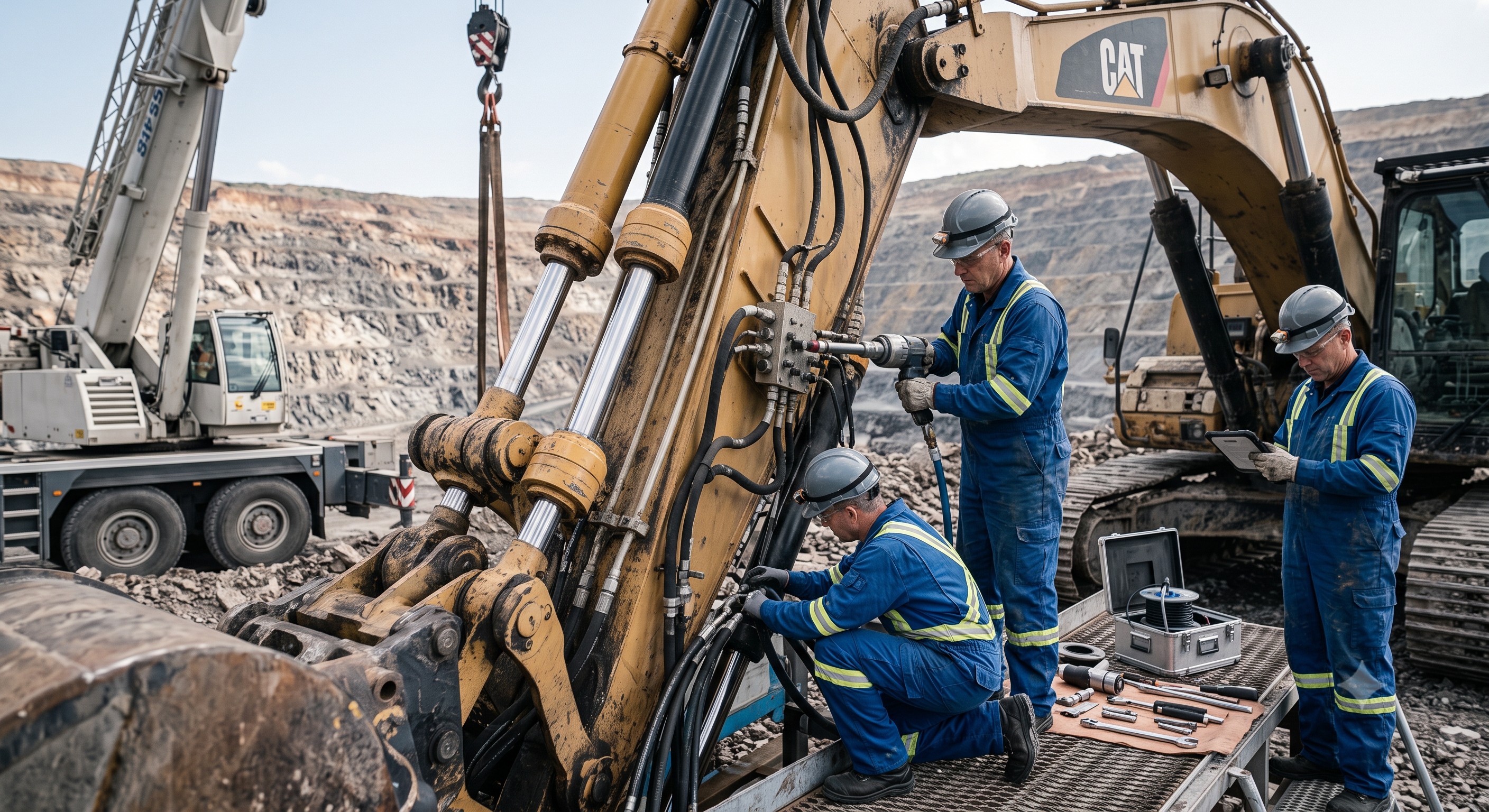
The most common and costly failures in hydraulic excavators involve the hydraulic main pump, undercarriage, engine turbocharger, final drive motors, and boom/arm cylinders . The cost of replacing a hydraulic main pump can range from $25,000 to $45,000, often triggered by contaminated hydraulic oil . Undercarriage replacement, frequently needed by 4,000 hours in abrasive mining applications, costs between $30,000 and $60,000 . Other expensive repairs include final drive motor issues ($15,000-$28,000) and turbocharger problems ($12,000-$25,000) . Failure to conduct proper preventive maintenance, such as hydraulic oil analysis and track tension monitoring, significantly accelerates these failures and drives up costs.
Q6: When should I replace the hydraulic fluid and filters?
The hydraulic oil change interval is typically extended to 3,000 operating hours, though this is a guideline; regular oil analysis (Cat S.O.S.) is recommended for accurate, periodic assessment of fluid condition . Hydraulic filters should be inspected and changed more frequently, often as part of daily or 60-hour checks . Modern fleet management systems provide real-time monitoring alerts, such as hydraulic filter clog detection, to prevent costly downtime . Adhering to a strict schedule for hydraulic fluid and filter changes is essential for preventing contamination, which is a root cause of major main pump failures .
Q7: How can I extend the service life of a hydraulic excavator beyond 15,000 hours?
An excavator's service life can be extended to 20,000+ hours with an exceptional maintenance program that includes phased rebuilds of major systems and strict adherence to operational best practices . Key phases include a 10,000-hour complete rebuild (engine, hydraulics, undercarriage) and a 16,000-hour complete restoration (factory-level rebuild of all systems) . Continuous monitoring of geomechanical conditions and adapting maintenance schedules based on wear and failure statistics is also critical . Excavators achieving these high-hour milestones with good maintenance records can retain 25-35% of their original value, compared to only 8-12% for poorly maintained units .
Q8: What engine emissions standards apply to hydraulic excavators for mining?
Hydraulic excavators are available with engines that comply with a range of emissions standards, including US EPA Tier 4 Final and European Stage V, with some models offered without the need for diesel exhaust fluid (DEF) . For example, the Cat 6040 is available with engines compliant with Tier 4 Final/Stage V standards . Furthermore, Komatsu offers its PC9000-12 with diesel Tier 4, diesel unregulated, or electric drive options, allowing mining companies to select the configuration that best fits their site-specific requirements and regulatory obligations .