

Introduction: Navigating the Compact Excavator Market in 2026
The construction and heavy equipment industry is currently witnessing a significant paradigm shift towards compact, versatile machinery to address shrinking urban job sites and stringent emissions regulations. The mini excavator, the second most popular category of construction equipment after compact track loaders, has become the go-to solution for contractors, municipalities, and owner-operators . The market's rapid growth—projected to reach nearly $70.3 billion by 2030—has intensified competition, leading to a wider range of choices for buyers . This guide provides a technical deep dive into mini excavator direct purchase prices and specifications, empowering you to make data-driven procurement decisions. We will analyze the core powertrain, hydraulic systems, and key metrics that define performance and Total Cost of Ownership (TCO), focusing on models under 6 tons, which dominate the small-scale construction, landscaping, and utility sectors .
Core Powertrain & Structural Design: Engineering Durability and Performance
The modern mini excavator is a testament to advanced engineering, balancing power, precision, and durability. At its heart lies a robust powertrain and a meticulously designed hydraulic system.
Engine Technology and Emission Compliance
The engine is the powerhouse, with most leading manufacturers, including Cat, Kubota, and Yanmar, providing Tier 4 Final and EU Stage V compliant diesel engines . These power units, often in the 20-75 horsepower range for this size class, utilize advanced fuel injection and after-treatment systems to reduce emissions without sacrificing performance. For instance, the Cat C2.8 and C3.3B engines feature a 'fit for life' no-maintenance diesel oxidation catalyst and diesel particulate filter, significantly reducing downtime . The selection of a high-quality engine, such as a Kubota D902 or D1105 found in many direct-purchase models, is a key indicator of reliability and long-term value .
Hydraulic System Efficiency and Precision
Hydraulic performance directly translates to productivity. Sophisticated load-sensing hydraulic systems with variable displacement pumps are now standard, optimizing flow and pressure based on demand for smooth, precise control . For example, the Cat 306 features a system pressure of approximately 3,600 psi and a max flow of 24 gal/min, enabling it to run a wide variety of heavy-duty attachments . The introduction of features like the Bobcat E20's closed-center hydraulic system with a load-sensing pump enhances finesse for tasks like grading and trenching . High auxiliary circuit pressures, often exceeding 4,000 psi, ensure the machine can handle demanding attachments like breakers and augers .
Structural Integrity and Undercarriage Durability
Durability is paramount, with manufacturers adhering to ISO 10262:1998 (Level I/II) and ISO 12117-2:2008 standards for ROPS/FOPS protection . The chassis, boom, and arm are constructed from high-tensile steel, designed to withstand the rigors of heavy earthmoving . The undercarriage, available with rubber tracks for urban environments or steel with pads for abrasive terrain, is engineered for stability and minimal ground pressure . Features like variable-width tracks, as seen on the Bobcat E20, allow the excavator to fit through narrow gateways while maintaining a stable working platform .
Technical Specifications: A Comparative Overview
The following
| Key Parameter | Technical Specification |
|---|---|
| Engine Model / Power | Cat C3.3B / 69.5 hp (Cat 310) | Kubota D902 / 19.5 hp (Bull 18-X) | Develon / 24.7 hp (DX35Z-7) |
| Operating Weight | 23,002 lb (Cat 310) | 4,008 lb (Rippa R18 Pro) | 9,259 lb (New Holland E42D) |
| Hydraulic System Type | Load Sensing with Variable Displacement Piston Pump (Cat 310) |
| Max. Dig Depth | 205.2 in (Cat 310) | 81.1 in (Bull 18-X) | 10 ft 8 in (Develon DX35Z-7) |
| Breakout Force (Bucket) | 17,459 lbf (Cat 310) | Up to 4,144 lbf (Bull 18-X) | 7,281 lbf (JCB 45C) |
| Emissions Compliance | U.S. EPA Tier 4 Final / EU Stage V (Standard for most models) |
| Safety Certification | ISO 12117-2:2008 (ROPS) & ISO 10262:1998 (FOPS) typically met |
| Direct Purchase Price (USD) | $25,000 - $60,000 (Sub-6T) | $14,900 (Bull 18-X) | $22,000-$28,000 (Rippa R32 Pro) |
Comparative Advantage: Analyzing TCO and ROI
A direct-purchase strategy for mini excavators offers a compelling value proposition, particularly when evaluating the Total Cost of Ownership (TCO) and Return on Investment (ROI).
Direct Purchase Pricing and Market Positioning
The market offers a wide spectrum of direct purchase prices. A new mini excavator in 2026 typically ranges from $25,000 to $60,000 for sub-6-ton models, with popular 3-ton class models falling between $40,000 and $120,000 depending on configuration and technology packages . Manufacturers like Bull Equipment and Rippa have aggressively entered the U.S. market with direct-to-consumer models priced 30% to 40% lower than established brands, with models like the 18-X starting at $14,900 . These high-value offerings are often equipped with globally recognized components, such as Kubota engines and Parker hydraulics, challenging the value proposition of premium-tier brands like Caterpillar and Deere, which command higher prices for advanced technology integration and brand equity .
Fuel Efficiency and Operational Cost Analysis
Fuel is a significant operational expense, and modern mini excavators are engineered for improved fuel efficiency. Features like auto idle, economy work modes, and efficient hydraulic systems contribute to a reduction in fuel consumption. Caterpillar, for instance, claims up to 10% lower total ownership costs due to improved fuel efficiency and extended service intervals . John Deere and Hitachi also integrate economy modes that reduce engine speed during normal work, lowering both fuel consumption and noise levels .
Long-Term Value and Resale Considerations
TCO extends beyond purchase price to include maintenance, repair, and resale value. Brands like Kubota and Cat maintain a strong resale value due to their extensive dealer networks and parts availability . However, the new entrants are countering this by stocking wear parts in U.S. warehouses for next-day processing and offering comprehensive warranties, such as Bull Equipment's 24-month limited warranty, to mitigate downtime and reduce TCO . The ability to run a wide array of attachments, facilitated by standard hydraulic quick couplers and high-flow auxiliary circuits, also enhances ROI by increasing machine utilization across different jobs .
Heavy-Duty Application Scenarios: Real-World Performance
The effectiveness of a mini excavator is best demonstrated in its application across various demanding sectors. The versatility offered by modern specifications makes them indispensable tools.
[CONTENT_IMAGE_2]Construction and Urban Development
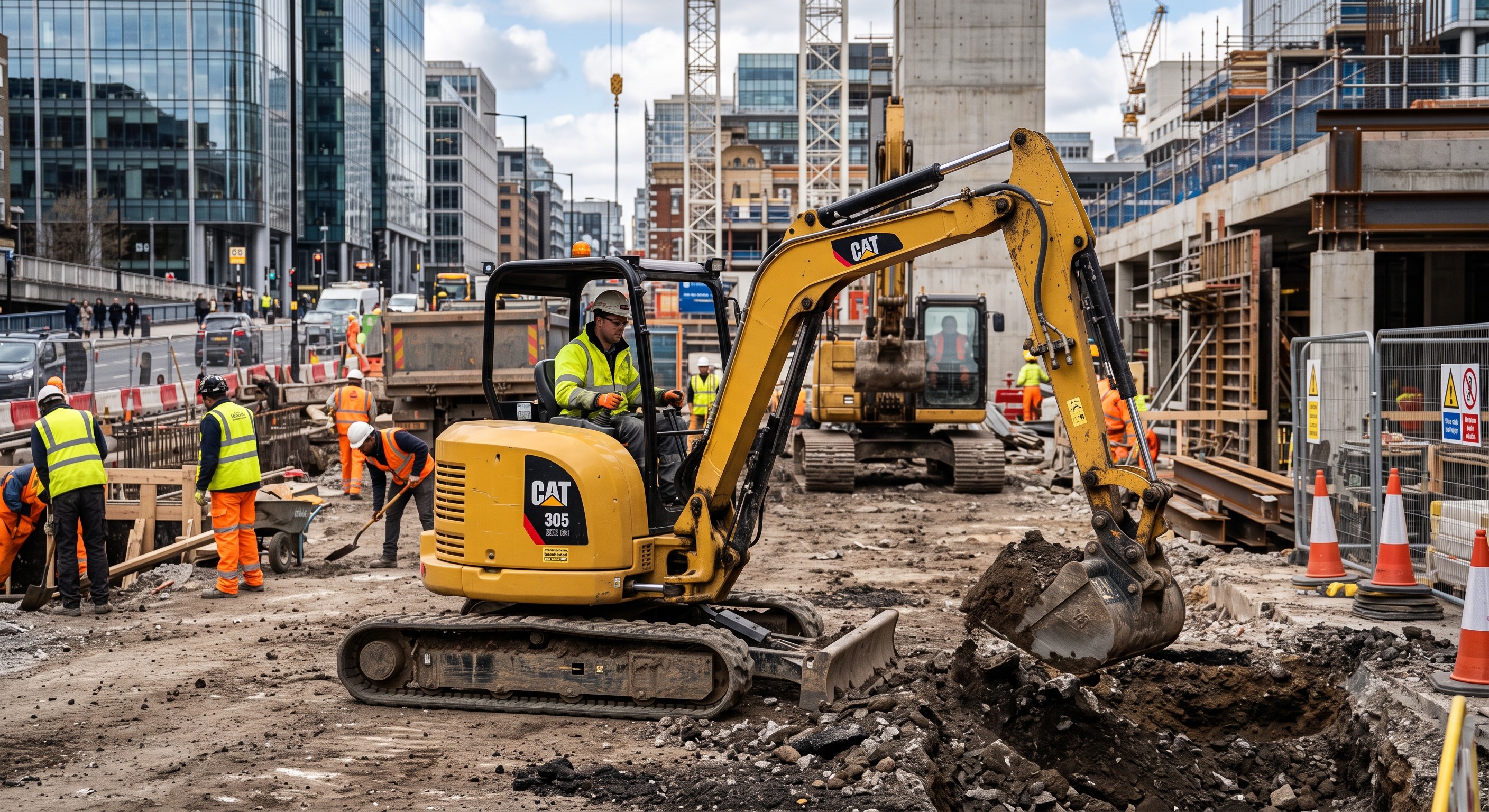
Mini excavators are the backbone of residential and commercial construction. Their compact size allows them to navigate tight lots and work close to structures, making them ideal for excavating foundations, utility trenching, and installing septic systems . The availability of zero-tail-swing models, such as the Develon DX35Z-7 or Bobcat E35, allows operators to work safely against walls and other obstacles . Advanced features like Cat's E-Fence software further enhance safety by preventing the excavator from hitting nearby obstacles .
Mining, Earthmoving, and Heavy Earthworks
In quarry operations, mining, and large-scale earthmoving, 5- to 6-ton class machines provide the necessary power and stability. The Cat 306, with its impressive lifting capacity of up to 7,500 lbs over the front and a max dig depth of 18 ft 1 in, is frequently chosen for utility trenching and foundation preparation in these demanding settings . The high hydraulic pressure, often exceeding 4,000 psi, enables these machines to effectively operate heavy attachments like hydraulic hammers and rippers, making them suitable for rock breaking and overburden removal .
Landscaping and Agricultural Applications
For landscaping and agricultural tasks, precision and minimal ground disturbance are key. Models like the Yanmar ViO series, with their zero-tail-swing and offset boom capabilities, are perfect for digging around retaining walls and trees without damaging root systems . The ability to swiftly attach various implements like augers for fence posts, grading buckets for land leveling, and forks for material handling makes the mini excavator an extremely versatile tool on a farm or ranch .
Conclusion: Optimizing Industrial Productivity with Strategic Procurement
The 2026 mini excavator market presents a robust spectrum of options for the discerning buyer, from high-value, direct-purchase models to premium, technology-laden machines. A successful procurement strategy hinges on aligning the machine's core technical specifications—engine power, hydraulic pressure, operating weight, and digging depth—with the specific demands of your application. By utilizing a detailed specification guide and performing a rigorous TCO analysis that considers upfront price, fuel efficiency, and maintenance costs, contractors can significantly enhance their operational productivity and ROI. As the industry continues to evolve towards greater efficiency and lower emissions, the mini excavator stands as a testament to the power of compact, engineering-driven solutions .